
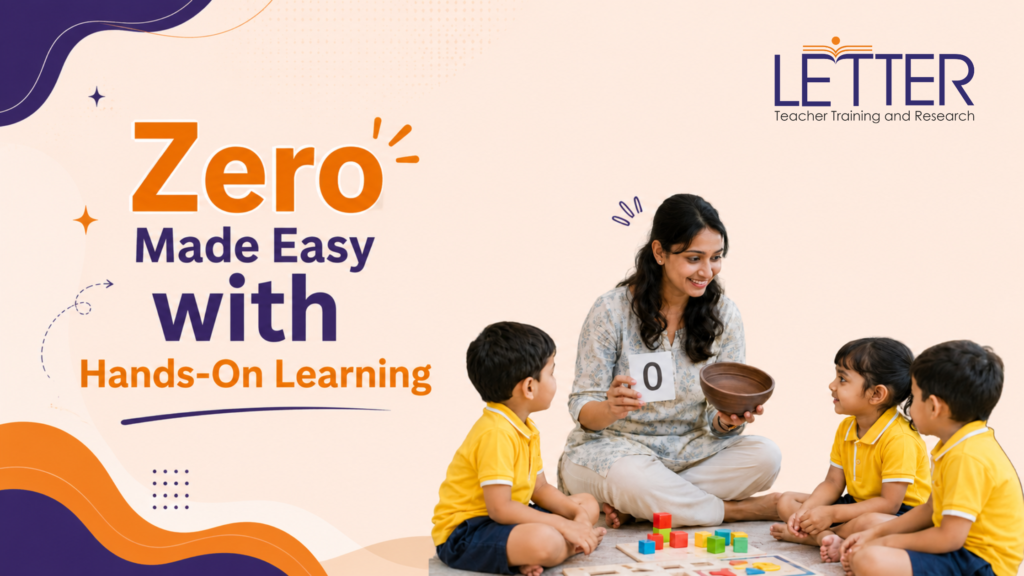
Children learn best when learning feels like play. At this age, they understand concepts better through activities, visuals, and real-life experiences rather than only listening to explanations. That is why teaching aids become such an important part of early childhood education. A simple teaching aid can turn even a difficult concept into something fun, meaningful, and easy for a child to remember.
One concept that many children find confusing in the beginning is the number zero. Children can easily count one apple, two toys, or three pencils because they can see and touch them. But explaining “nothing” to a small child can be tricky. Instead of asking children to simply memorize the number, I introduced zero through a very simple hands-on activity using materials easily available at home.
What is a Teaching Aid?
A teaching aid is any material used to help children understand a concept in a simple, practical, and interesting way. It encourages children to observe, participate, and learn through experience instead of rote memorization.
Teaching aids are especially useful for preschool children because:
- They make learning enjoyable
- They improve attention and concentration
- They help children remember concepts better
- They encourage curiosity and classroom participation
- They support practical and experiential learning
Young children naturally learn more when they can see, touch, and interact with things around them.
Teaching Aid for Introducing Zero
For this activity, I used a very simple teaching aid made with household materials. The idea was to help children visually understand that zero means “nothing” or “empty.”
Materials Required
- One bowl or basket
- Small toys, chocolates, or blocks
- A flashcard with the number “0”
The best part about this activity is that it is affordable, easy to prepare, and can be used both in classrooms and at home by parents.
How to Introduce the Concept of Zero
First, I showed the children a bowl filled with small toys. The children became excited and immediately started counting them aloud.
Then, slowly, I removed each toy one by one while the children counted along with me.
Finally, when the bowl became empty, I showed it to the children and asked:
“What is left inside the bowl now?”
The children answered happily,
“Nothing!”
That became the perfect moment to introduce the concept.
I then said,
“When nothing is left, we call it ZERO.”
After that, I showed them the number flashcard “0” and encouraged them to repeat:
“Zero means nothing.”
The children quickly connected the empty bowl with the idea of zero because they could actually see and experience it.
How Parents Can Support This Learning at Home
Parents play a very important role in reinforcing concepts taught in school. The good news is that teaching zero at home does not require any special materials.
Parents can try simple activities like:
- Keeping a few biscuits on a plate and eating all of them
- Placing toys inside a box and removing everything
- Counting fruits and showing an empty basket afterward
Can ask simple questions like:
- “How many chocolates are left?”
- “What is inside the box now?”
When the child answers “nothing,” parents can gently say:
“That is called ZERO.”
Daily-life examples help children understand the concept naturally without pressure.
Parents should also:
- Encourage children to answer confidently
- Appreciate their efforts
- Keep learning playful and stress-free
- Repeat the concept through small everyday activities
- Children learn faster when school learning and home learning go hand in hand.
So teaching preschool children becomes more meaningful when concepts are introduced through simple and practical experiences. The concept of zero can easily be taught using everyday objects available at home or in the classroom. Through interactive teaching aids and support from parents, children begin to understand learning in a natural and enjoyable way. When children learn through experience, the concept stays with them for a much longer time.